

43 RV and Camping Terms: What Do They Mean?
If you are new to the world of camping, there are some vocabulary that can leave you scratching your head. Although our list is not comprehensive, we want to familiarize you with some frequently used camping terms.
Camping Dictionary
30amp/50amp – Campers generally run on either 30 or 50 amp power. Most campgrounds with electric hookups offer 30 amps at their sites. Campgrounds that list 50 amp service will usually have 30 amp service, but it is best to check. There are adapters available that allow campers that require 30 amp service to hook up to a 50 amp outlet (Check it out on Amazon), and adapters that will let campers that require a 50 amp service hookup to a 30 amp outlet (Check it out on Amazon). Adapters are also available that allow you to hook up a 30 amp or 50 amp cord to the standard 15 amp outlet at your house.
Basement – The storage area within the bottom of your camper that can be accessed from the outside.
Black Water – Water that comes from your toilet. Black water contains human waste.
Boondocking – Camping without hookups. Freshwater tanks are used for water, and a generator or solar power is used for electricity. You can boondock just about anywhere.
Bumper Pull – Another term for a travel trailer.
China Bombs – Tires made in China for travel trailers and fifth wheels. many campers believe that these tires are defective and will blow out sooner rather than later. Owners often change their “China bombs” immediately after purchase as these tires usually come stock on campers.
Chocks – Hard plastic or rubber objects placed in front of and/or behind camper tires so that the tires do not roll. (Check them out on Amazon)
Class:
A – These are RVs that are drivable and have flat front ends. Class A’s are the largest of the drivable RVs, thus providing the most square feet of living space.
B – Small, drivable RVs. They resemble large vans and are often referred to as camper vans.
C – Drivable campers that are generally larger than Class B RVs but smaller than a Class As. Class C RVs are usually built on truck chassis and contain over the cab bunk or storage areas.
Coach – A drivable RV.
Dry Camping – Another term for boondocking.
Dump Station – A designated location where you dump your wastewater when a full hookup is not available. Campgrounds without sewer hookups typically have dump stations. Camping retail stores such as Camping World and truck stops may have dump stations to accommodate boondockers who need to dump their waste.
Fifth Wheel – This camping term indicates a type of camper pulled behind a pickup truck where the camper connects to a hitch located in the bed of the pickup.

Fiver (5er) – A fifth wheel.
Fresh Water Tank – A tank in campers that stores fresh water. Campers have built-in water pumps that disseminate water from the freshwater tank throughout the camper.
FHU – Full hookup.
Full Hookup – A campsite that always includes water, electric, and sewer hookups. These hookups can sometimes include cable television, but it is best to check with the campground.
Full Timers – Campers who live in their RVs rather than in traditional houses.
Grey Water – Water that comes from your sinks and showers. Greywater does not include human waste.
Holding Tanks – Tanks in campers that hold water. There are generally two types of holding tanks, those for grey and blackwater. Greywater tanks contain all non-sewer water. Blackwater tanks hold water that comes from your toilet. Many people will include the freshwater tanks when referring to holding tanks.
Honey Wagon – Some campgrounds that do not have sewer hookups will offer a service where an employee will come to your campsite and empty your holding tanks. This is referred to as a honey wagon.
Motor Home – A drivable RV.
Newbie – Campers that are new to camping and RVs.
Outdoor Kitchen – A kitchen that can be accessed from the outside of a camper. Outdoor kitchens are typically fitted with grills, burners, and sinks.
Pop-Up Camper – Compact (foldable) campers that are pulled behind tow vehicles. This camping term is for campers that can unfold and expand into larger campers when set-up.
Pull Through – A campsite with two entry points so that you can enter by pulling straight through the campsite rather than backing in.
RVs – Recreational vehicles that contain living quarters.
Self-Contained – Campers that are supplied with everything needed for boondocking. Self-contained campers have a generator or solar for electric power and use freshwater tanks to supply running water.
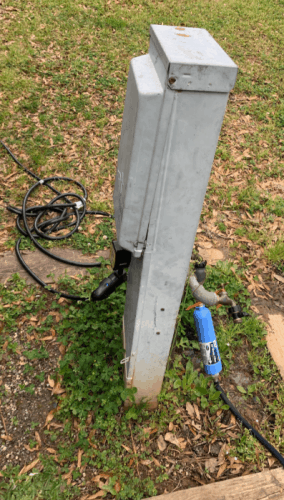
Shore Power – The electric hookups that provides power to your camper.
Slide Out – A camper or RV section that mechanically slides out to provide extra square footage inside the camper.
Snowbirds – People from the north who travel south to live in warmer climates during the winter months.
Sticks and Tin – This term is associated with travel trailers and fifth wheels, especially those made of aluminum. These campers have a wood frame and aluminum siding, or “sticks and tin.”
Stinky Slinky – The hose that hooks to your sewer connection to empty your grey and black water tanks. (Check it out on Amazon)
TOAD (Dinghy) – A vehicle towed by a drivable camper. Many camper owners that drive Class A or Class C RVs will also tow a vehicle to drive around once they arrive at their destination. This camping term for the vehicle is the TOAD.
Toy Hauler – A camper that contains a large room in the rear that can be accessed through a ramp door. The room is made for hauling “toys” such as golf carts, motorcycles, and/or all-terrain vehicles.
Travel Trailer – A camper that is pulled behind a tow vehicle.
Truck Camper – An RV that is made to be carried in the bed of a truck.
TT – A travel trailer.
TV – The tow vehicle for a camper or fifth wheel. Usually, tow vehicles refer to pickup trucks, but any vehicle that pulls a camper or fifth wheel is considered a tow vehicle.
Water/Electric – A type of campsite that has both water and electric hookup options. If the listing for a campsite only includes water and electricity, it will not have other sewer or cable options.
Workamping – People who work at campgrounds in exchange for a place to camp. Often, workampers will work and receive free camping, although some receive payment as well.
Do you have any camping terms that we should add to our list? We would love to hear from you. Please drop us a line in the comment section below.


Going to need to know all of this. My next vacation will be using a RV to see this great nation of USA. Thanks for sharing.
Thank You, Have Fun!